
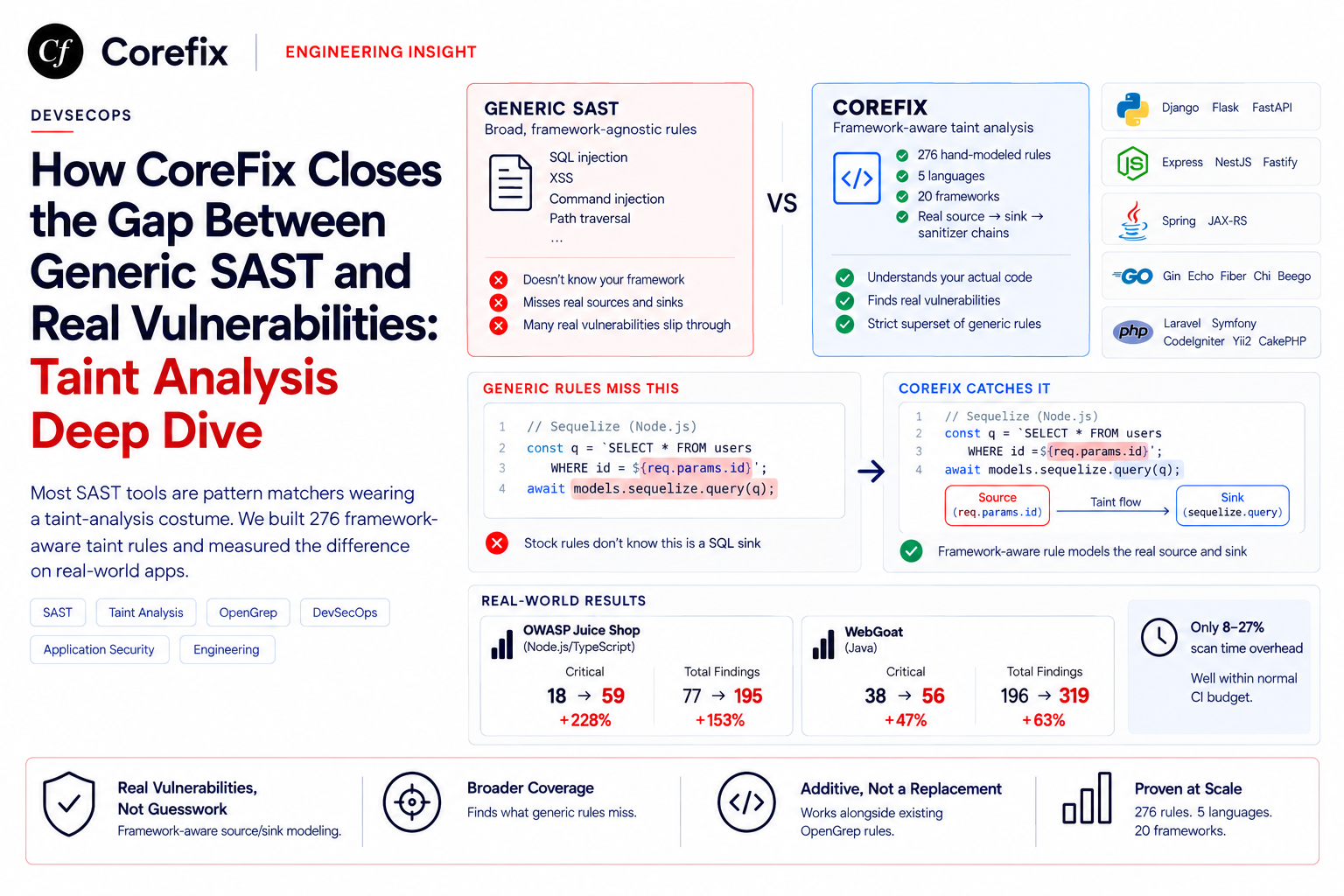

Static analysis tools have a dirty secret: most of them are pattern matchers wearing a taint-analysis costume. They ship with generic rule packs — "SQL injection," "XSS," "command injection" — that look impressive on a feature list but were never taught what your actual framework's request object looks like, or which of its ORM/query-builder calls are dangerous.
We ran an experiment to measure exactly how big that gap is, and what closing it does to real-world detection rates.
The Problem: Generic Rules Don't Know Your Framework
Opengrep (the OSS engine underlying most modern SAST tooling) ships with registry configs like p/security-audit and p/owasp-top-ten. These are broad, framework-agnostic rule packs, and its taint engine (--taint-intrafile) is genuinely capable of tracing how untrusted data flows from a source to a dangerous sink — but only for the sources and sinks someone explicitly modeled.
That's the catch. A generic ruleset knows that connection.query() or cursor.execute() are dangerous SQL sinks in the abstract. It usually does not know that:
models.sequelize.query(...)in a Sequelize-backed Express app is a SQL sinkjdbcTemplate.query(...)in a Spring controller is a SQL sinkYii::$app->db->createCommand(...)in a Yii2 PHP app is a SQL sink@RequestParam-annotated Spring parameters, or@Query()-decorated NestJS parameters, are tainted request input in the first place
The engine isn't the bottleneck. The rule content is. Without framework-specific source/sink modeling, taint analysis silently does nothing on the exact code patterns real applications are built from.
What We Built
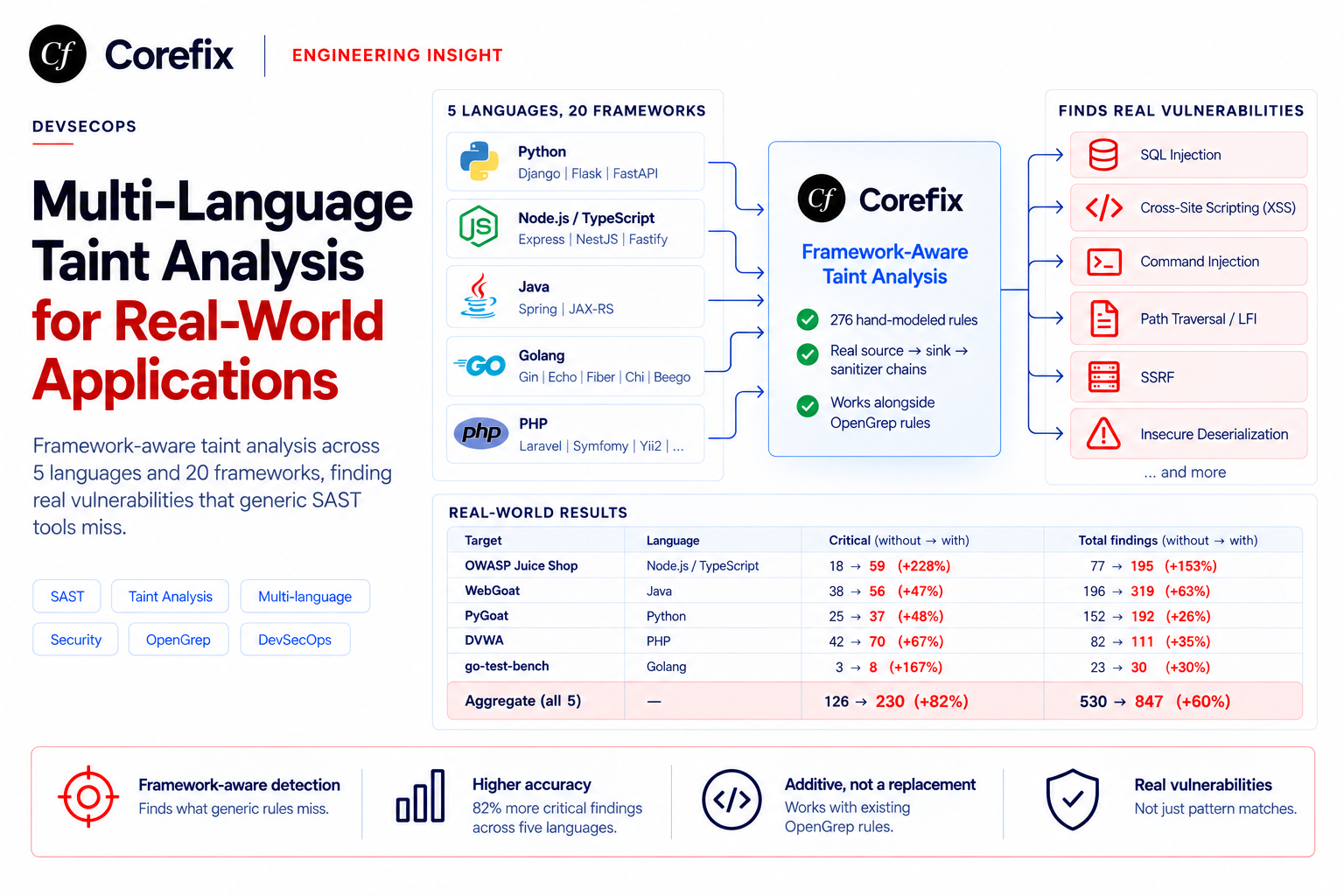
CoreFix closes this gap with a custom Opengrep taint-mode rule library: 276 hand-modeled rules across 5 languages and 20 frameworks — Python (Django, Flask, FastAPI), Node.js/TypeScript (Express, NestJS, Fastify), Java (Spring, JAX-RS), Golang (Gin, Echo, Fiber, Chi, Beego), and PHP (Laravel, Symfony, CodeIgniter, Yii2, CakePHP), each with a framework-agnostic fallback tier for uncovered code.
Every rule models a real source → sink → sanitizer chain for that framework specifically, covering SQL injection, command injection, SSRF, path traversal / LFI, XSS, server-side template injection, XXE, insecure deserialization, NoSQL injection, open redirect, CRLF injection, unrestricted file upload, and a few ecosystem-specific classes (prototype pollution for Node, LDAP injection for Java). A minimal example of what that looks like for a Django SQL injection rule:
mode: taint
pattern-sources:
  - pattern: request.GET.get(...)
  - pattern: request.POST.get(...)
pattern-sinks:
  - pattern: $CURSOR.execute($QUERY)
    focus-metavariable: $QUERY
pattern-sanitizers:
  - pattern: django.db.connection.ops.quote_name(...)
Nothing exotic — just precise knowledge of what "untrusted input" and "dangerous call" actually look like in that framework's idioms, instead of a generic guess.
We wired this in additively, alongside Opengrep's existing registry configs (--config auto, p/security-audit, p/owasp-top-ten), so it's a strict superset of what a stock Opengrep setup already finds — not a replacement.
The Benchmark
We ran full scans of two industry-standard vulnerable-by-design applications — OWASP Juice Shop (Node.js/TypeScript/Express) and WebGoat (Java) — with and without the custom taint rules, everything else held constant (same Opengrep version, same registry configs, same target checkout).
OWASP Juice Shop
| Without custom rules | With custom rules | Change | |
|---|---|---|---|
| Critical | 18 | 59 | +228% |
| Medium | 54 | 131 | +143% |
| Low | 3 | 3 | — |
| Total findings | 77 | 195 | +153% |
WebGoat
| Without custom rules | With custom rules | Change | |
|---|---|---|---|
| Critical | 38 | 56 | +47% |
| Medium | 155 | 260 | +68% |
| Low | 0 | 0 | — |
| Total findings | 196 | 319 | +63% |
The critical-severity jump is the headline: Juice Shop's critical findings more than tripled, almost entirely from SQL injection and XSS patterns that generic rules simply had no sink modeling for — Sequelize/Knex query-builder calls, template-literal-built SQL, and unescaped response writes that stock Opengrep configs walked right past. WebGoat's Spring/JDBC-based critical findings grew by nearly half from the same class of gap on the Java side.
Scan time overhead for loading and running an additional 276 rules: 8–27%, well within normal CI budget.
Why This Matters
Every one of these additional critical findings represents a real vulnerability class — SQLi, XSS, command injection, SSRF — that a stock Opengrep configuration, and by extension any tool built on top of it without doing this modeling work, would have missed entirely. Not because the underlying dataflow engine can't trace it, but because nobody told it where to look.
This is the core of CoreFix's approach: deterministic, auditable taint analysis that's actually taught your stack's idioms, rather than a generic ruleset hoping your code happens to match a pattern written for someone else's framework.
What's Next
This taint rule library handles intra-file, intra-function dataflow — the case where source and sink live in the same function. The next phase of this work extends detection to inter-procedural flows, where tainted data crosses file and function boundaries before reaching a sink, using call-graph resolution paired with bounded LLM reasoning to catch the business-logic and multi-hop vulnerability classes that pure pattern matching structurally cannot reach.
We'll publish those results as they land.